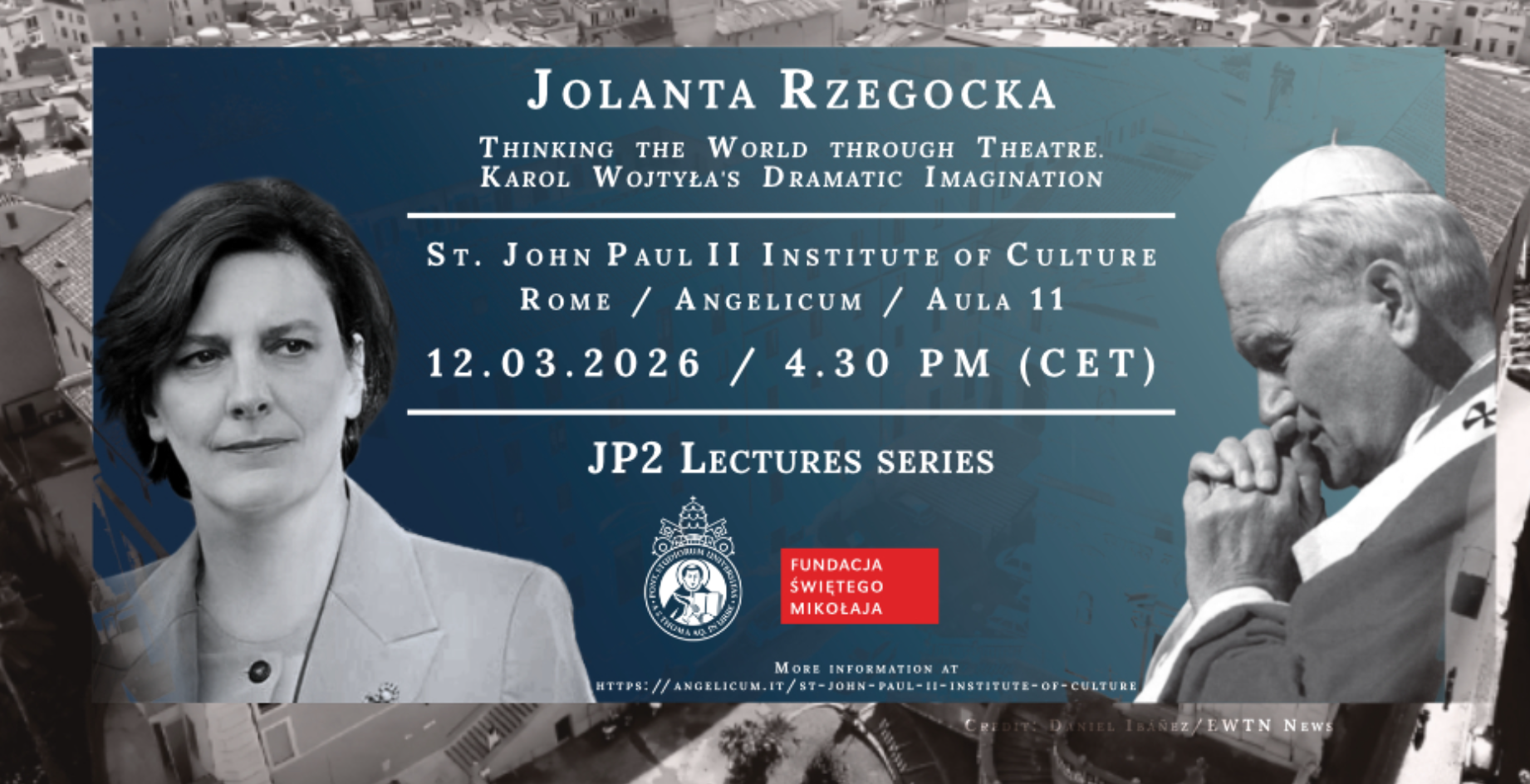
Everyone is invited to join the next JP2 Lecture by Dr Jolanta Rzegocka.
Among the many languages Karol Wojtyła used to read the world, the language of theatre was central. It accompanied him from school drama in Wadowice and the rituals of the Polish festive and liturgical year, through the spectacle of sport and the early plays of a student at the Jagiellonian University, to the hushed, clandestine readings of the Rhapsodic Theatre under Nazi occupation—and ultimately to the theatre of war and peace itself. Across these forms runs a theatrical continuum through which Wojtyła’s generation expressed, tested, and questioned its place in history. For Wojtyła, theatre was never mere performance: it was a mode of thinking, a way of shaping experience, and a means of confronting suffering, vocation, love, and responsibility. In this lecture, Jolanta Rzegocka will revisit Wojtyła’s dramatic works to argue that theatrical metaphor and practice enabled him to rethink humanity’s relation to the Creator, to language, to culture, and to the self—and to ask what this restless theatrical energy might still offer us today.
Dr Jolanta Rzegocka is an Associate Professor of Anglo-American Literature at the Jesuit University Ignatianum in Kraków and a historian of early modern theatre. Her research explores theatre as a social and cultural practice that shaped public virtues, participation, and collective memory. She is the author of Watching the Virtues: Playbills, Drama and the Teaching of Civic Virtue in the Jesuit Theatre of Poland–Lithuania (Brill, 2025). She is a research member of the COST Action Prayticipate, examining participation through prayer in the late medieval and early modern world. She has also hosted Res Poloniae: At Home with Poland (TVP Kultura), a cultural history series—including a dedicated Italian cycle—on Poland’s artistic and intellectual connections with Europe.